
Red meat: investing in grass-based cattle and sheep production
By Paul McMahon
First appeared in Agri Investor in June 2015
Why Meat?
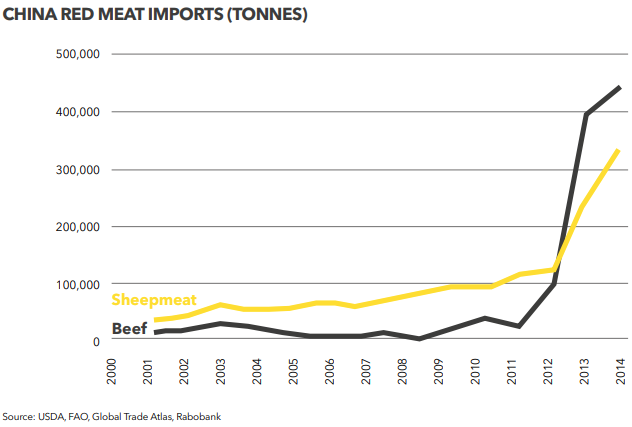
Over the past decade, billions of dollars of institutional capital have flowed into farmland. Most has gone into row crops or permanent crops. However, investors are now looking to livestock as a source of diversification and potentially higher returns. Meat is where global demand is growing most strongly. Prices are at all-time highs: for example, the Eastern Young Cattle Indicator in Australia set a new record of A$4.58 ($3.7; $3.2) per kg in April 2015. And there are opportunities to deploy capital to improve grassland management and enhance returns. WHY MEAT? The story about Asia’s growing demand for meat is well known. Incomes are rising, dietary preferences are changing and people are eating more meat as they join the middle class. The effects can be seen in the recent explosion of Chinese beef imports. China imported 800,000 tonnes of beef and sheepmeat in 2014, compared to less than 150,000 tonnes five years ago. A nation that was for decades self-sufficient is increasingly turning to global markets to meet its appetite.
On the other hand, supply is constrained because of droughts (in the USA), disease (parts of Brazil) and conversion of pasture to other uses (dairy in New Zealand). As a result, red meat prices have reached record highs in recent years. And according to the latest projections from the OECD and FAO, prices are likely to remain high for the next decade – in marked contrast to the commodity cereals grown on most arable land.
How to invest
The macro story for red meat is positive. But how should this meat be produced? And what is the best way to invest in this trend? One option is to raise animals in confinement on concentrated feeds – primarily soybeans, maize or other cereals. About 40 percent of all the cereals grown in the world now go to feed animals in this way; 85 percent of soybeans are processed into meal for animals.
But this is a precarious business model. Animal producers are intermediaries, caught between feed prices that they can’t control and meat prices that they must accept. Price-takers to the power of two, they suffer from volatile earnings. For example, Purdue University calculated that the US hog industry lost $4 billion in 2012 when the rising price of maize and soybeans pummelled margins. Cattle feedlots and chicken producers faced a similar storm. The most important driver of profits is often skill at hedging markets – which makes it an unattractive play for an investor who wants the security of real assets.
There is a different way, especially for red meat – raising animals on pasture. Grasslands cover 3.5 billion hectares, or 26 percent of the planet’s ice-free landmass. This is where grazing ruminants, such as cattle and sheep, belong. Indeed, grasslands and grazing animals have co-evolved and both require each other to function properly. In regions with extensive grasslands, an appropriate climate, good infrastructure and competitive land prices – unskewed by lifestyle buyers, for example – grass-based systems can be the lowest-cost form of meat production.
The challenge is dealing with climate variability. Native grasslands are usually found in areas of low or intermittent rainfall – if they were wetter, they would probably be forest. Dry periods combined with poor management can degrade pastures. Either production collapses, or farmers are forced to buy expensive feed for the animals, which puts them back on the high-input, high-cost treadmill they were trying to avoid.
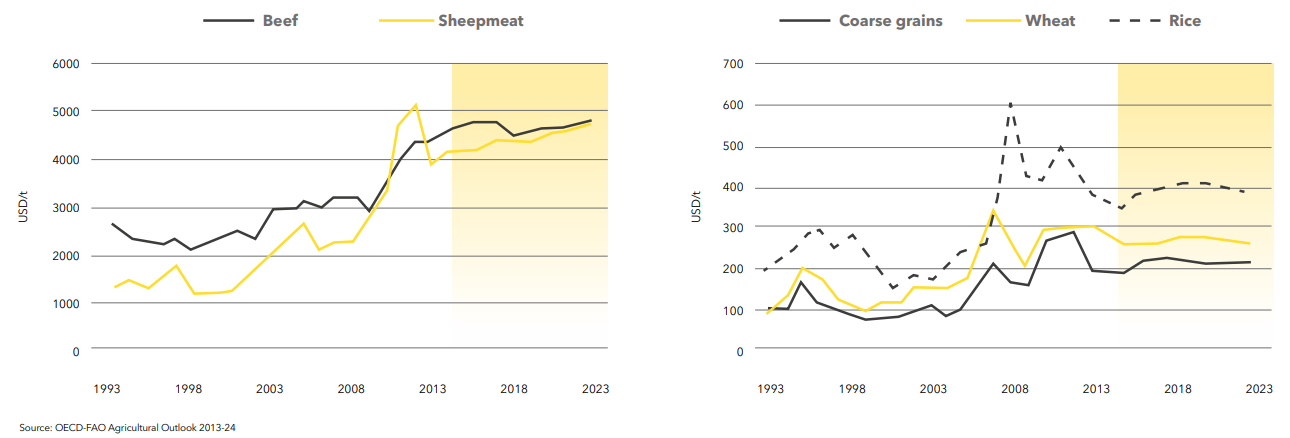
OECD-FAO Price projections for food commodities
The Opportunity to Improve Management
However, with the right management, these problems can be overcome. Careful investment in infrastructure – especially stockwater and fencing – together with innovative forms of rotational grazing – a process known as ‘holistic planned grazing’ where animals are moved in large mobs – can ensure that pastures get the right amount of animal impact and then sufficient time to recover. This builds soil fertility, increases grass productivity and improves animal health – allowing stocking rates to double or triple. These grazing systems also give the farmer greater visibility into the amount of grass available, allowing animal numbers to be adjusted accordingly. The result is a more resilient system.
Grass-based cattle and sheep operations, when properly managed, are the lowest cost producers of red meat. Once the land has been acquired and properly developed, there should be little need for feed, fertilisers, chemicals or other inputs. Machinery can be kept to a minimum. The primary asset is the land and efforts can be focused on increasing the quality and the value of the land through the management of livestock.
Consumer Appeal
At the other end of the supply chain, there is increasing consumer recognition of the health benefits of grass-based meat, which is higher in omega-3 fatty acids, conjugated linoleic acid and antioxidant vitamins. For example, a new Pasturefed Cattle Assurance Scheme launched in Australia in 2013 has seen rapid take-up and is already paying premiums of up to 10 percent to participating farmers. Demand for grass-fed beef and lamb in North America greatly exceeds domestic supply, leading to even higher price premiums.
There is also the opportunity to tell a positive environmental story. Red meat has got bad press recently, as multiple studies point to the impacts of current production models – land degradation, greenhouse gas emissions, water pollution, antibiotic over-use, competition with food crops. But livestock on native grasslands, when managed properly, can regenerate soils, put carbon in the ground, fix water cycles and close nutrient loops. The animals shouldn’t need drugs, because they are healthier, and they don’t compete with food crops, as people can’t eat grass. It is another reason why consumers are prepared to pay premiums for pasture-raised meat.
Producing meat in a way that takes out many of the input costs, achieves higher output prices and increases the value of the underlying asset (the land) – this is the sort of opportunity that investors may want to look at.